Vietnam’s 2025 low-altitude economy forum and the $10 billion industry

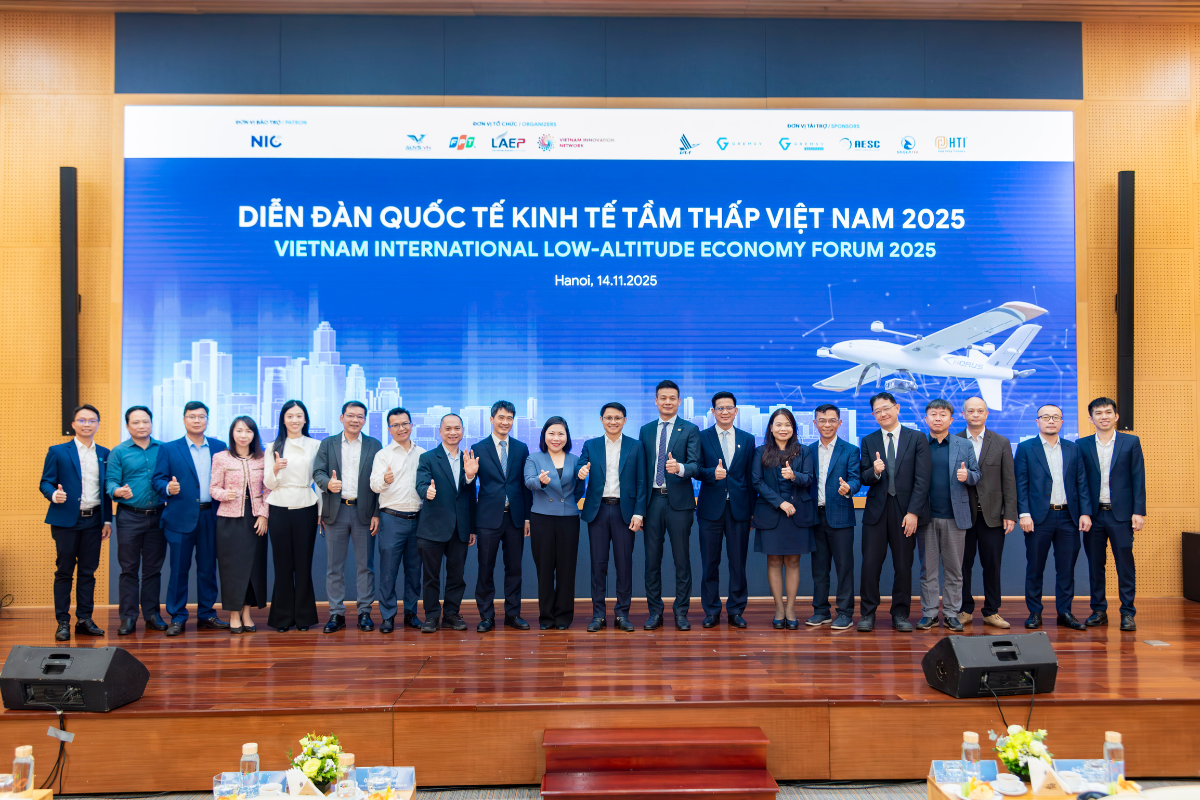
On November 14, 2025, Mr. Phung Thanh Trinh, CEO and Founder of XBStation, attended the International Low-Altitude Economy Forum with the theme “Shaping the Future of Low-Altitude Economy in Vietnam from Policy to Practice.” This event marked a significant milestone, opening a strategic vision to transform the previously underutilized low-altitude airspace into a new, high-potential economy.
1. UAVs drive exponential productivity growth
One of the key points highlighted at the forum was the role of unmanned aerial vehicles in boosting labor productivity dramatically. Specifically, Mr. Vu Anh Tu, Chief Technology Officer of FPT Corporation, noted that low-altitude economy solutions can increase productivity exponentially compared to traditional methods.
He cited an example in agriculture where a UAV equipped for spraying can cover 60 to 70 hectares per day, whereas a skilled worker using manual methods can only manage around 1 hectare.

This stark difference demonstrates the power of UAVs, which reduce labor costs, save time, increase efficiency, and lower human-related risks. When widely applied, UAVs can become a key tool to restructure multiple industries, from agriculture, rescue operations, and environmental monitoring to delivery services, creating a new leap in economic productivity.
2. An industry projected to reach USD 10 billion
Experts believe the low-altitude economy holds significant potential, reflected in several aspects. Globally, the low-altitude aviation sector, including UAVs, eVTOL aircraft, and low-altitude flight services, is estimated to reach 700 billion USD by 2035. In Vietnam, this economy is projected to reach approximately 10 billion USD at the same time. Regarding employment, Mr. Vu Anh Tu stated that if developed strategically, this model could create one million high-quality jobs for the young workforce.
A major step in realizing this potential was the establishment of the Low-Altitude Economy Partnership on October 10, 2025. The alliance brings together businesses, research institutes, and universities to promote the development of low-altitude industries, including key sectors such as UAVs, eVTOLs, low-altitude air traffic networks, AI, and unmanned traffic management systems. XBStation is also a member of this alliance.
At the forum, Mr. Tran Anh Tuan, CEO of the Vietnam Aviation, Space, and UAV Network, emphasized that Vietnam has the opportunity to become a hub for low-altitude industries. He highlighted advantages such as geopolitical position, core technological potential, hardware manufacturing capabilities, and a growing ecosystem of supporting industries.
3. Global market momentum and golden opportunity for Vietnam
Experts analyzed international market dynamics and why Vietnam can leverage global opportunities to advance. According to Mr. Vu Anh Tu, the global low-altitude aviation technology market has already reached hundreds of billions of USD and is growing at a rate of approximately 30 percent annually. This trend is reinforced as major powers such as the United States, China, and the European Union have identified it as a strategic industry.
In this context, Vietnam has clear opportunities, with the Mekong Delta highlighted as a prime pilot region. It is not only a strong area for UAV applications in agriculture but also a testing ground for many international companies.
4. Key policy recommendations
At the forum, experts and business leaders proposed several strategic recommendations to establish a sustainable development framework for Vietnam’s low-altitude economy. Key points include:
4.1 Sandbox framework
Create legal sandbox areas where UAV and eVTOL companies can conduct test flights, collect data, and develop services without overly strict regulations. This policy encourages innovation while ensuring flight safety and effective airspace coordination during the early stages.
4.2 Low-altitude airspace management infrastructure
Develop unmanned traffic management systems (UTM) integrating AI software, 3D digital maps, and flight management databases. Invest in monitoring stations and low-altitude communication networks to ensure safe and efficient UAV operations.
4.3 Encourage UAV and UAM research and manufacturing
Support domestic companies to invest in research and development for UAVs, vertical take-off and landing vehicles, and supporting hardware. Provide incentives such as tax breaks and state funding for startups in the low-altitude technology sector to promote “Made in Vietnam” products in both software and hardware.
Read more:
XBStation showcases XBLink at SEMIEXPO Vietnam 2025
XBStation partners with the Vietnam Low Altitude Economy Forum 2025
MobiFone Solution and XBStation officially establish a strategic partnership
4.4 Develop high-quality human resources
Train engineers, UAV pilots, and airspace management specialists. Promote collaboration between businesses, universities, and research institutes to develop specialized training programs. Encourage the establishment of centers for UAV training, maintenance, and operations.
4.5 Strengthen international cooperation
The Low-Altitude Economy Partnership can act as a bridge between Vietnam and international partners to attract investment, share technology, and exchange management experience. Actively participate in global low-altitude aviation networks to learn and apply international best practices.
The International Low-Altitude Economy Forum highlighted that Vietnam is at the threshold of a significant opportunity in low-altitude aviation. With geopolitical advantages, skilled human resources, and contributions from technology companies such as XBStation, Vietnam has the potential to become a global hub for the low-altitude economy.